Choosing a home EV charger: a UK buyer's guide for 2026
Last checked
By HomeTechSift editorial · Last checked 12 November 2026 · 10 min read


Power, tethered or untethered, solar and tariff features, the UK smart-charging rules and the £500 grant for flats and renters. Plus six current chargers with installed prices (checked 12 Nov 2026).
A home charger is the cheapest and easiest way to charge an electric car if you have off-street parking. This guide explains the specs that matter, the rules every UK charger must meet, the grants available and what named chargers cost installed. How we assessed this: specs, maker price pages and official guidance, not hands-on testing.
How a home EV charger works
A home charger is a wall box on its own circuit that supplies AC power to the car's onboard charger. The car decides how fast it can accept power, up to the charger's limit.
On a single-phase supply that limit is about 7 kW; the Ohme Home Pro is rated 7.4 kW and 32 A (Ohme). A three-phase supply allows up to 22 kW, but few homes have one (myenergi).
Smart chargers connect to the internet to schedule charging for cheap hours and must meet the GB smart charge point rules (legislation.gov.uk).
Step-by-step buying advice
1. Check off-street parking and your supply. You need a driveway or garage. Ask the installer to check your main fuse and consumer unit.
2. Choose your tariff first. An EV tariff may only work with certain chargers or cars. Intelligent Octopus Go, for example, needs a compatible car or charger (Octopus Energy).
3. Decide tethered or untethered, and the cable length needed to reach your car's charge port.
4. Solar? If you have panels, consider a charger that can use surplus solar.
5. Compare installed prices and what a 'standard install' covers (cable length, earthing, groundwork).
6. If you rent or own a flat, apply for the OZEV grant before installation (GOV.UK).
What to look for
Power: most UK homes have a single-phase supply, which limits home chargers to about 7 kW. Ohme's Home Pro, for example, is rated 7.4 kW (Ohme).
Tethered or untethered: tethered chargers have the cable attached; untethered ones have a socket for your own cable. Pod Point sells the Solo 3S in both versions (EDF/Pod).
Tariff integration: smart chargers can schedule charging for cheap overnight rates. Check your supplier's tariff works with the charger before you buy.
Solar: if you have solar panels, chargers such as the myenergi zappi can divert surplus solar into the car (myenergi).
Connectivity: Wi-Fi, Ethernet or a built-in 4G SIM. 4G helps if your Wi-Fi doesn't reach the drive.
UK costs: kit, installation and running
Installed prices for mainstream 7 kW chargers sit around £949 (≈ $1,272) to £1,100 (≈ $1,474) for a standard install (see the table). Long cable runs, groundwork or a consumer unit upgrade cost extra (our calculation from figures checked 12 Nov 2026).
Your installer must notify the work under Building Regulations (Part P in England) and should check whether your supply needs upgrading with the network operator.
Running cost depends on your tariff: charging on an off-peak EV tariff costs much less than the standard rate, which is why tariff integration matters.
UK costs at a glance
Installed: £949 (≈ $1,272) (Ohme ePod, checked 12 Nov 2026) to £1,099 (≈ $1,473) (Hypervolt Home 3 Pro or tethered zappi via OVO, checked 12 Nov 2026) for a standard install (Ohme; OVO; OVO).
Running: 26.32p/kWh on the current cap against 6.5p/kWh on Intelligent Octopus Go's smart-charging rate (Ofgem price cap, 1 Oct–31 Dec 2026, Direct Debit average, checked 12 Nov 2026; Octopus Energy, checked 12 Nov 2026).
Running costs: worked example
Assumptions: 8,000 miles a year at 3.5 miles per kWh (an assumption; check your car's real efficiency) = about 2,286 kWh a year.
On the price cap: 2,286 kWh × 26.32p ≈ £602 a year (Ofgem price cap, 1 Oct–31 Dec 2026, Direct Debit average, checked 12 Nov 2026).
On Intelligent Octopus Go's smart-charging rate: Octopus quotes charging from 6.5p/kWh on its 12-month fixed tariff (Octopus Energy), checked 12 Nov 2026. 2,286 × 6.5p ≈ £149 a year, a saving of about £453.
Charging time: adding 60 kWh at 7.4 kW takes about 8 hours (60 ÷ 7.4 ≈ 8.1), so an overnight off-peak window covers most top-ups.
Grants
From 1 April 2026, the OZEV grant for renters and flat owners is worth up to £500 per socket. You need dedicated off-street parking and an eligible vehicle, and you must apply before the installation (GOV.UK), checked 12 Nov 2026.
Owners of houses with a driveway aren't eligible for this grant; the scheme runs to 31 March 2027 (GOV.UK).
UK smart-charging rules
Since 2022, chargers sold for home use in Great Britain must meet the Electric Vehicles (Smart Charge Points) Regulations 2021 (legislation.gov.uk).
They must be smart, come with default charging hours outside the weekday peaks of 8–11am and 4–10pm (which you can change or override), and apply a random delay of up to 10 minutes when charging starts (legislation.gov.uk; regulation 11).
This is why a new charger may not start charging at the exact second your cheap rate begins.
DIY or professional fitting?
Home chargers are fixed electrical installations on a dedicated circuit, so use a qualified, registered electrician or the maker's installer network. This isn't a DIY job.
Most makers quote a 'standard installation' price; Pod Point's covers up to 15 m of cable and the typical electrical protection (EDF/Pod).
The Energy Saving Trust explains how smart charging shifts charging to cheaper, greener times (Energy Saving Trust).
Compatibility
Car: all the chargers here use the Type 2 connector standard on UK EVs; untethered units need a Type 2 cable.
Tariffs: check the charger is approved for your tariff. Ohme, Hypervolt, myenergi and Pod Point list supported tariffs on their sites.
Solar: the myenergi zappi is designed to divert surplus solar into the car (myenergi).
Supply: most homes are single-phase, which limits charging to about 7 kW; 22 kW needs a three-phase supply (myenergi).
Ways to pay
Charger plus installation: most makers quote one price for a standard install, for example £999 (≈ $1,339) for the Ohme Home Pro (checked 12 Nov 2026) and £949 (≈ $1,272) for the Ohme ePod (checked 12 Nov 2026) (Ohme).
Charger only: if you already have an electrician, some chargers are sold on their own. myenergi lists the zappi from £779 (≈ $1,044) (myenergi), checked 12 Nov 2026, and Andersen lists the A3 from £995 (≈ $1,333) (Andersen), checked 12 Nov 2026.
Subscription: Pod sells its charger for £34 (≈ $45.57) a month for 36 months with £99 (≈ $133) upfront (Pod). That's about £1,323 (≈ $1,773) in total over 36 months (£34 (≈ $45.57) × 36 + £99 (≈ $133)), about £324 (≈ $434) more than the £999 (≈ $1,339) 'from' price for buying outright (EDF/Pod) (our calculation from figures checked 12 Nov 2026).
Through your energy supplier: OVO lists Hypervolt and myenergi chargers from £1,099 (≈ $1,473) installed (OVO), checked 12 Nov 2026.
Supply upgrades and load balancing
A 7 kW charger draws up to 32 A (the Ohme Home Pro is rated 7.4 kW / 32 A, per Ohme), a large share of a typical home supply. Your installer should check the main fuse and may fit load-management (a current clamp) so the charger slows down when the house is using a lot of power.
If the supply needs upgrading, ask the installer who arranges it with your network operator and who pays, before you sign.
Ohme's own installation guide lists five things to check before your installation, including the survey (Ohme).
Durability, warranty and support
Chargers live outdoors, so check the IP rating: the Ohme Home Pro is rated IP55 and comes with a 3-year warranty (Ohme).
Ask who handles faults: the maker, the installer or your energy supplier, if you bought through one. Keep the installation certificate and the charger's serial number, as you'll need them for warranty claims and for a grant if one applied.
If you move house, a tethered charger usually stays with the property, so factor that into the price.
Solar and EV charging
If you have solar, a charger that diverts surplus can charge from your own generation. Going Solar UK describes the zappi's Eco+ mode as charging only from surplus solar, pausing when clouds pass (Going Solar UK).
Without solar, Going Solar UK says a cheaper tariff-led charger such as Ohme usually makes more sense (Going Solar UK).
Privacy and security
Smart chargers connect to the maker's cloud and record your charging times. The 2021 regulations require chargers to meet security requirements, including protection of data and secure updates (legislation.gov.uk).
Use a strong, unique password for the charger app and turn on two-step verification if offered (NCSC).
Current models compared
Prices checked 12 November 2026; they change often, so check the source.
| Model | UK price | Pros | Cons |
|---|---|---|---|
| Ohme Home Pro | £999 (≈ $1,339) installed (checked 12 Nov 2026; check site) (source) | On-unit display and built-in 4G; £999 (≈ $1,339) installed (checked 12 Nov 2026) | Tethered only |
| Ohme ePod | £949 (≈ $1,272) installed (Ohme, checked 12 Nov 2026) (source) | Lowest installed price here, £949 (≈ $1,272) (checked 12 Nov 2026) | Untethered, so you need your own Type 2 cable |
| Pod Point Solo 3S | From £999 (≈ $1,339) installed (checked 12 Nov 2026; check site) (source) | Tethered or untethered, from £999 (≈ $1,339) installed (checked 12 Nov 2026) | Pod's subscription option costs more overall than buying outright. |
| Hypervolt Home 3 Pro | From £1,099 (≈ $1,473) installed (via OVO; checked 12 Nov 2026; check site) (source) | Solar modes and a choice of colours | From £1,099 (≈ $1,473) installed, £100 (≈ $134) more than the Ohme Home Pro (checked 12 Nov 2026) |
| myenergi zappi | £949 (≈ $1,272) socketed or £1,099 (≈ $1,473) tethered, installed via OVO (checked 12 Nov 2026; check site) (source) | Designed to charge from surplus solar | Pays off mainly if you have solar panels |
| Andersen A3 | From £995 (≈ $1,333) for the charger; installation extra (Andersen, checked 12 Nov 2026) (source) | Design-led, with a cable that winds away | £995 (≈ $1,333) for the charger alone; installation extra (checked 12 Nov 2026) |
US dollar prices are estimates converted from the UK £ price at £1 = $1.3402 (21 Oct 2026 rate). The £ price is the one we checked; check the retailer for current pricing.

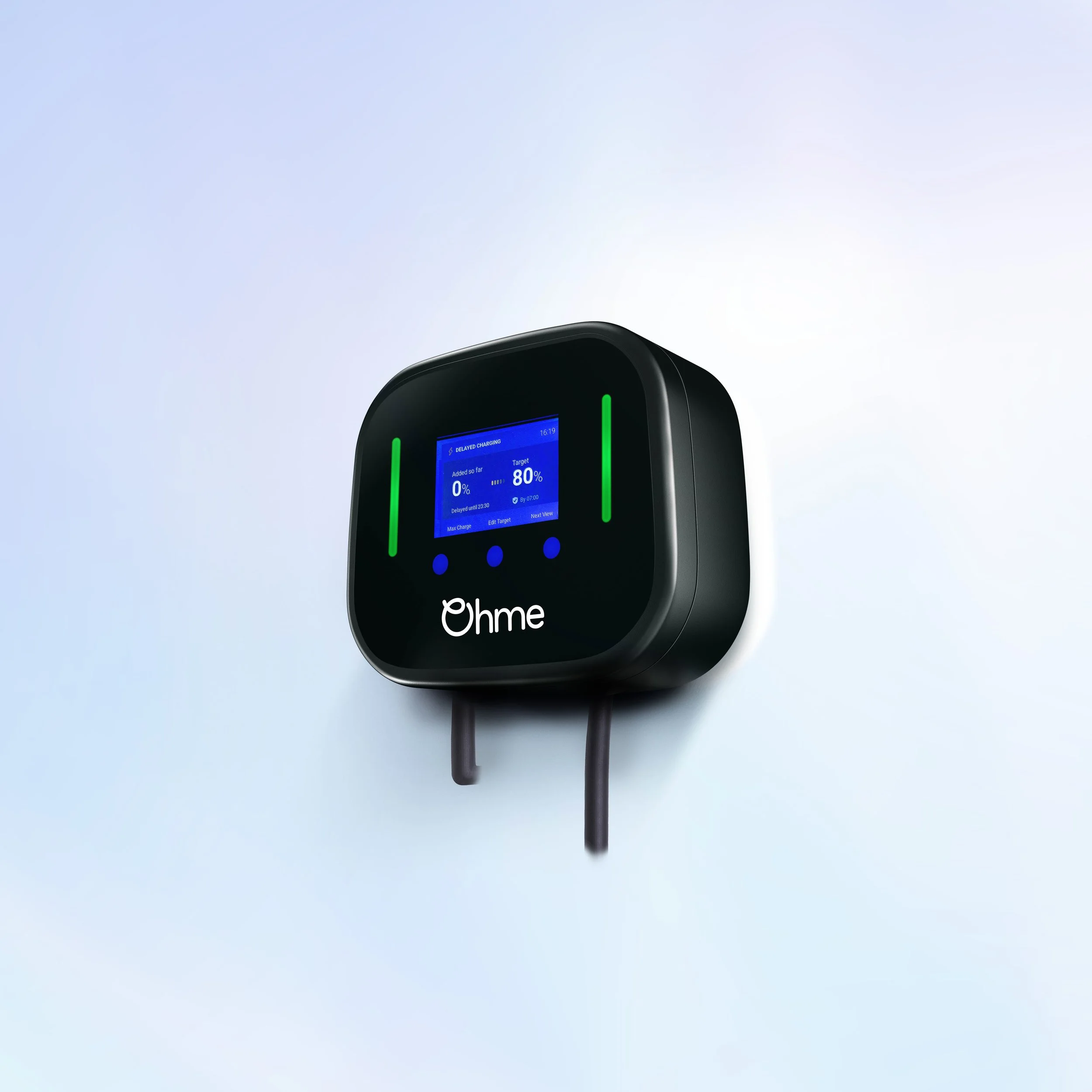
Ohme Home Pro
£999 (≈ $1,339) installed (checked 12 Nov 2026; check site) · price source
Suits: Drivers who want a display on the unit, a 5 m tethered cable and 4G built in

Ohme ePod
£949 (≈ $1,272) installed (Ohme, checked 12 Nov 2026) · price source
Suits: A cheaper, compact untethered unit with Ohme's tariff integration
Pod Point Solo 3S
From £999 (≈ $1,339) installed (checked 12 Nov 2026; check site) · price source
Suits: Buyers who want a widely installed charger with simple pricing


Hypervolt Home 3 Pro
From £1,099 (≈ $1,473) installed (via OVO; checked 12 Nov 2026; check site) · price source
Suits: People who want solar matching and a choice of colours

myenergi zappi
£949 (≈ $1,272) socketed or £1,099 (≈ $1,473) tethered, installed via OVO (checked 12 Nov 2026; check site) · price source
Suits: Solar owners who want to charge from surplus solar

Andersen A3
From £995 (≈ $1,333) for the charger; installation extra (Andersen, checked 12 Nov 2026) · price source
Suits: Buyers who care about design and a cable that winds away neatly
Installer and safety
A chargepoint is a fixed electrical installation on a dedicated circuit, so use a registered electrician or the maker's installer network.
For the flats and renters grant, the installer must be authorised and you mustn't have the chargepoint installed until OZEV confirms you're eligible (GOV.UK).
Ask the installer to check your main fuse, consumer unit and earthing, and whether load management is needed (Ohme).
Keep the installation certificate and serial number for warranty claims.
Not financial advice
This is general information, not financial advice. Grant eligibility, tariff rates and savings depend on your home and usage; check the official scheme or supplier page before you decide.
Best for: quick summary
No scores: this is who each model suits, based on the sources below.
- Ohme ePod: Lowest installed price here.
- Ohme Home Pro: An on-unit display and 4G built in.
- Pod Point Solo 3S: Simple pricing in tethered or untethered versions.
- myenergi zappi: Solar owners.
- Hypervolt Home 3 Pro: A choice of colours with solar features.
- Andersen A3: Design-led homes.
Common mistakes
- Buying before checking your supply: an old fuse or consumer unit can add hundreds of pounds.
- Picking a charger your energy tariff doesn't support.
- Choosing tethered with a cable that won't reach your car's charge port.
- Expecting 22 kW at home: most homes are single-phase.
- Applying for the flats/renters grant after installation.
FAQ
Is a 3-pin plug enough?
It works but is slow; a dedicated 7 kW charger is much quicker and is designed for long, regular loads.
Can I get a grant for a charger at my house?
Not if you own a house with a driveway; the OZEV grant is for renters and flat owners (GOV.UK).
Why didn't my charger start at midnight?
UK rules require a random delay of up to 10 minutes (legislation.gov.uk).
How much can an EV tariff save?
In our worked example, about £453 a year compared with the price cap (Ofgem price cap, 1 Oct–31 Dec 2026, Direct Debit average, checked 12 Nov 2026; Octopus Energy).
What does a standard installation include?
It varies: Pod Point's covers up to 15 m of cable and typical electrical protection (EDF/Pod). Get the inclusions in writing.
Can I install one if I rent?
Yes with permission, and you may get up to £500 per socket (GOV.UK), checked 12 Nov 2026.
What does the default off-peak setting do?
New chargers come set to avoid 8–11am and 4–10pm on weekdays, but you can change it (legislation.gov.uk).
Will it work without Wi-Fi?
Some units have built-in 4G; the Ohme Home Pro does (Ohme).
How much is the OZEV grant now?
Up to £500 per socket from 1 April 2026, up from £350, for the flats and renters, residential landlord and on-street parking grants, which run until 31 March 2027 (GOV.UK), checked 12 Nov 2026.
Is there VAT relief on a home charger?
No. HMRC's zero-rate list for energy-saving materials doesn't include EV chargers (GOV.UK).
Can I take my charger with me if I move?
Possibly, but it needs disconnecting and refitting by an electrician.
Does my energy supplier need to know?
Tell them if you switch to an EV tariff; your installer handles any network operator notification.
Sources
- https://ohme-ev.com/our-chargers/
- https://ohme-ev.com/product/ohme-home-pro/
- https://www.edfenergy.com/campaign/ev-charging
- https://www.ovoenergy.com/electric-cars/smart-charger/hypervolt
- https://www.ovoenergy.com/electric-cars/smart-charger/myenergi
- https://www.myenergi.com/product/zappi-ev-charger/
- https://andersen-ev.com/pages/andersen-a3
- https://www.legislation.gov.uk/uksi/2021/1467/made
- https://www.legislation.gov.uk/uksi/2021/1467/regulation/10/made
- https://www.legislation.gov.uk/uksi/2021/1467/regulation/11/made
- https://www.gov.uk/guidance/changes-to-electric-vehicle-chargepoint-grant-schemes-from-1-april-2026
- https://www.gov.uk/guidance/electric-vehicle-chargepoint-grants
- https://energysavingtrust.org.uk/advice/smart-charging-electric-vehicles/
- https://www.ofgem.gov.uk/your-energy-supply/your-energy-bill/energy-price-cap-unit-rates-and-standing-charges
- https://octopus.energy/smart/intelligent-octopus-go/
- https://www.gov.uk/guidance/vat-on-energy-saving-materials-and-heating-equipment-notice-7086
- https://goingsolaruk.co.uk/zappi-myenergi-ev-charger-review/
- https://podenergy.com/home/home-charging
- https://ohme-ev.com/support/5-things-you-should-know-about-your-ev-charger-installation/
- https://www.ncsc.gov.uk/guidance/smart-devices-in-the-home
Last checked 12 November 2026. How we assessed this: specs, published tests and owner reports, not hands-on testing.
Images: Pod Point Solo 3S (universal/untethered): David T at Pod Point / Wikimedia (CC BY-SA 4.0; resized (full-size, 800 px and 480 px versions), converted to WebP and AVIF, and cropped on display to fit the page's image frames; licence terms). Hypervolt Home 3 Pro: Bertiewooster1987 / Wikimedia (CC BY-SA 4.0; resized (full-size, 800 px and 480 px versions), converted to WebP and AVIF, and cropped on display to fit the page's image frames; licence terms). Ohme Home Pro: Ohme (Ohme Marketing Hub image ('HomePro_LightWorld_PrespectiveView_wCables.jpg', Ohme Home Pro product images); Ohme's Head of PR confirmed by email on 26 Oct 2026 that the hub's images are copyright free and available for us to use; no credit line was specified, so credited © Ohme; cropped, resized and converted to WebP/AVIF. Source: Ohme marketing hub (press images)). Ohme (Product photo from the source page; no written reuse licence found. Used for editorial illustration of the exact model, with credit and a link to the source page.; licence terms). myenergi (Product photo from the source page; no written reuse licence found. Used for editorial illustration of the exact model, with credit and a link to the source page.; licence terms). Andersen EV (Product photo from the source page; no written reuse licence found. Used for editorial illustration of the exact model, with credit and a link to the source page.; licence terms).